
Collaboration continued: LBG x VINTAGE MARTINI
Part 2: Archival Fashion in Dialogue with Leigh Merrill’s Window and Wind: Exploring Fragmentation, Archive, and Time Through Digital Collaboration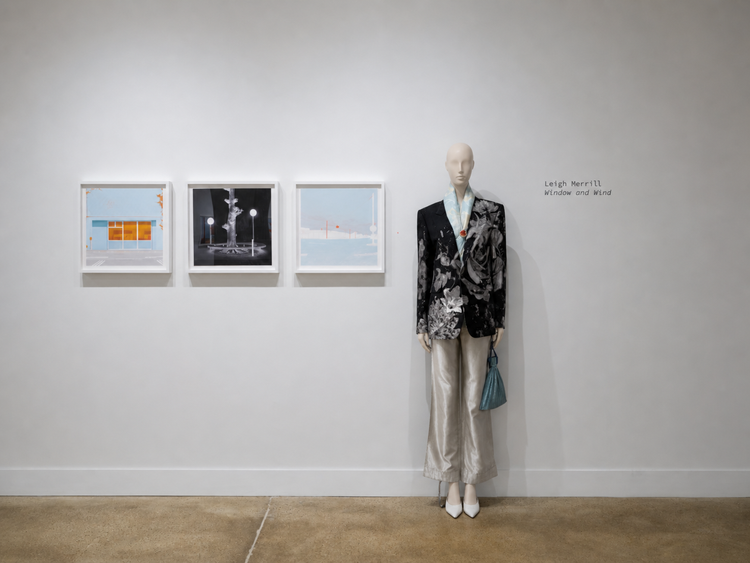
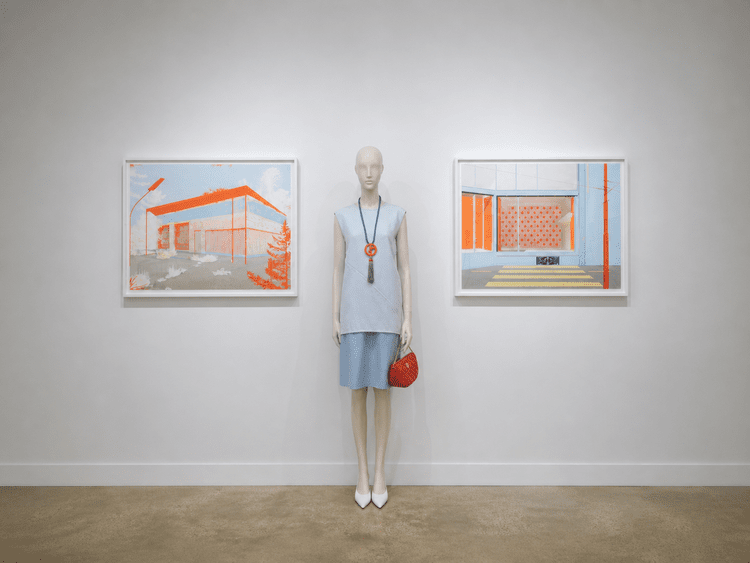
Last week, Liliana Bloch Gallery and Vintage Martini launched a digital collaboration centered around Window and Wind, Leigh Merrill’s current exhibition on view through July 11. Through a series of digitally composed images, archival garments from Vintage Martini were placed in dialogue with selected works from the exhibition, creating visual relationships between contemporary photography and archival fashion.
While the collaboration takes shape through image and dress, it emerged from a deeper conceptual overlap between the two practices. Both are concerned with how meaning is constructed through fragments, how archives are activated in the present, and how past and present coexist through acts of recomposition.
Fragmentation and Assembly
In Window and Wind, Merrill constructs images through the layering, redaction, and recombination of thousands of photographic fragments drawn from diverse geographical locations. The resulting works are not documents of singular places, but carefully constructed environments assembled from multiple sources.
Vintage Martini operates through a similar process. Garments sourced across decades, designers, and contexts are brought together into new compositions through styling and curation. A garment created for one moment in history is placed alongside another from a different era, creating new relationships and new readings.
In both practices, meaning emerges not from the individual fragment itself, but from the relationships established between fragments. Images and garments become materials assembled into something larger than the sum of their parts. Through composition, disparate elements are transformed into new visual experiences.
Archive as Material
Photography and fashion are often understood as records of the past. Yet in both Merrill’s work and Vintage Martini’s archival practice, the archive functions as something more active.
Merrill works from an archive of photographs collected across places and time. Vintage Martini maintains an archive of garments that carry traces of past identities, histories, and cultural moments. Neither practice treats these materials as static artifacts. Instead, they become raw material for new forms of construction.
Photographic theorist Allan Sekula challenged the notion of the archive as a neutral repository. Rather than simply preserving information, he argued that archives actively organize, structure, and produce meaning. Seen through this lens, both Merrill’s photographs and Vintage Martini’s garments operate as living archives—continually reshaped through selection, juxtaposition, and context.
Fashion and Modernity
In Fashion and Modernity, Christopher Breward describes fashion as a system through which individuals situate themselves in time, continually constructing and reconstructing identity through change. Fashion is inherently tied to modernity because it exists in constant dialogue with the past while simultaneously moving toward the future.
This relationship to time offers another point of connection between the two practices. Merrill’s photographs collapse multiple places and moments into a single frame, creating spaces that feel familiar yet impossible to locate within a singular reality. Vintage fashion similarly allows historical objects to enter contemporary life, bringing garments from different eras into new conversations.
In both cases, time becomes layered rather than linear. Past and present coexist simultaneously, producing works that resist fixed temporal boundaries.
Re-contextualization and Meaning
Perhaps the strongest connection between these practices lies in the act of re-contextualization itself.
A photograph means something different when removed from its original location and incorporated into one of Merrill’s constructed environments. Likewise, a garment takes on new meaning when placed in a different context—whether within an archive, a museum, a contemporary wardrobe, or, in this case, alongside a work of art.
Neither practice simply preserves. Both transform. Meaning is not fixed within the image or object itself, but emerges through placement, relation, and context.
The collaborative images created by Liliana Bloch Gallery and Vintage Martini are rooted in this idea. Rather than illustrating the artworks directly, the archival garments function as parallel constructions, entering into dialogue with Merrill’s photographs through shared concerns of assembly, archive, memory, and time.
Window and Wind remains on view through July 11 at Liliana Bloch Gallery. Gallery hours are Thursday through Saturday, 12–5 PM, and by appointment.
Vintage Martini is open Monday through Saturday from 11 AM–6 PM and Sunday from 12–5 PM.
FEATURED WORKS
Leigh Merrill:
Orange Reflection (2025), Blue Road (2025), and Tree with Lights (2025), archival pigment prints on Hahnemühle Museum Etching paper, 16 x 16 inches, framed size 18 x 18 inches
&
Thistle (2025) and Window Wallpaper (2025), archival pigment prints on Hahnemühle watercolor paper, 34.5 x 43.5 inches